

Philosophy: Real peace and contentment in our lives come from realising that life is a process to engage in, a journey down a path that we can choose to experience as magical. When we subtly shift toward both focusing on and finding joy in the process of achieving instead of having the goal, we have gained a new skill. And once mastered, it is magical and incredibly empowering.
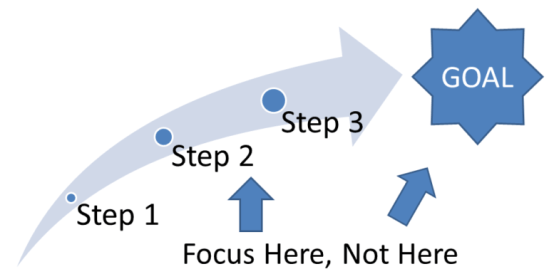
Aim: The aim is Progress, not perfection. The aim is being joyful in the present, not seeking happiness elsewhere.
Certainty: With deliberate and repeated effort, progress is inevitable.
Big Ideas:
1.If you are not in control of your thoughts, then you are not in control of yourself.
2.A paradox of life: The problem with patience and discipline is that developing each of them requires both of them.
3.We erroneously think that there is a magical point that we will reach and then we will be happy.
4.Education: when school funding is determined by how many high test scores we put out, what students actually learn is merely a footnote.
5.Japanese perfect plate story. “Why would I need someone to make sure I do my job correctly?”
6.Your goals are like a rudder on a boat, they provide direction. (Goals as rudder versus a dock?)
7.Judging your work is wasted energy that can’t go into the work.
8.Your goals are a compass, not the buried treasure. The goal is not the destination or where you end up, but rather the compass that guides the journey.
9.Zen concept of Beginners Mind. It’s harder to concentrate as you advance in skill level.
10.A habit is the “natural way we do something.”
11.There is no point of performance you can achieve where you will feel “done”.
12.Make time to just sit. You need relaxing time.

Explanation:
When we learn to focus on and embrace the process of experiencing life, whether we’re working toward a personal aspiration or working through a difficult time, we begin to free ourselves from the stress and anxiety that are born out of our attachment to our goals, our sense that ‘I can’t feel happiness until I reach my goal’.
This ‘goal’ always takes the form of someplace we have not yet reached, something we don’t yet have but will at some point, and then, we believe, all will be right in our life.
When we subtly shift toward both focusing on and finding joy in the process of achieving instead of having the goal, we have gained a new skill. And once mastered, it is magical and incredibly empowering.
However, the practicing mind is quiet. It lives in the present and has laser-like, pinpoint focus and accuracy. It obeys our precise directions, and all our energy moves through it. Because of this, we are calm and completely free of anxiety. We are where we should be at that moment, doing what we should be doing and completely aware of what we are experiencing. There is no wasted motion, physically or mentally.
If you are not in control of your thoughts, then you are not in control of yourself.
A paradox of life: The problem with patience and discipline is that developing each of them requires both of them.
We have a very unhealthy habit of making the product — our intended result — the goal, instead of the process of reaching that goal. We erroneously think that there is a magical point that we will reach and then we will be happy. The word practice implies the presence of awareness and will. The word learning does not. When we practice something, we are involved in the deliberate repetition of a process with the intention of reaching a specific goal.
When you focus on the process, the desired product takes care of itself with fluid ease. When you focus on the product, you immediately begin to fight yourself and experience boredom, restlessness, frustration, and impatience with the process. When you focus your mind on the present moment, on the process of what you are doing right now, you are always where you want to be and where you should be. In order to focus on the present, we must give up, at least temporarily, our attachment to our desired goal.
When you shift your goal from the product you are trying to achieve to the process of achieving it, a wonderful phenomenon occurs: all pressure drops away. We waste so much of our energy by not being aware of how we are directing it. Remember, judgment redirects and wastes our energy.
Analogy:

Ask yourself: at what point in a flower’s life, from seed to full bloom, has it reached perfection? Let’s look at this right now and see what nature is teaching us every day as we walk past the flowers in our garden. At what point is a flower perfect? Is it when it is nothing more than a seed in your hand waiting to be planted? All that it will ever be is there in that moment. Is it when it first starts to germinate unseen under several inches of the soil? This is when it displays the first visible signs of the miracle we call creation. How about when it first pokes its head through the surface and sees the face of the sun for the first time? All of its energies have gone into reaching for this source of life; until this point, it has had nothing more than an inner voice telling it which way to grow to find it. What about when it begins to flower? This is when its own individual properties start to be seen. The shape of the leaves, the number of blooms are all unique to just this one flower, even among the other flowers of the same species. Or is it the stage of full bloom, the crescendo of all of the energy and effort it took to reach this point in its life? Let’s not forget that humble and quiet ending when it returns to the soil from where it came. At what point is the flower perfect? I hope you already know that the answer is that it is always perfect.
Anxiety Attacks and Procrastination:
Think About Your Progress To Eliminate Anxiety.

Why, when an important deadline is approaching, do we seem to be able to procrastinate even more? Feeling that your focus disappears when you know you have serious work to do can be very stressful.
That is common because we are consumed with the thought of the end of our goal, which seems to be farther and farther, no matter how hard you work.
And that makes you feel discouraged and harms your productivity. Instead of focusing on the future consequences, you need to focus on the now to do your best.
You can do this with a simple change of perspective. Thinking about your goal can fill you with fear and anxiety, which will distract you from your task.
But if you keep your thoughts in the present moment, your anxiety will drop significantly. Put your ultimate goal aside for a moment, focus on your progress and you will feel much more motivated.
That does not mean that you should not focus on your goals.
Goals are vital, but they are not useful when used as an indicator of progress. Again, this can be very discouraging. Your goals should be used as a guide to get you in the right direction.
But for you to be guided, you also need to ensure that you can respond in a sensitive way to problems.
Rather than letting your emotions control your reactions, you need to take a step back and objectively evaluate what is working and what is not working at that moment.
Once you have done this, you can adjust your next attitudes.
Imagine yourself on a bowling alley: you do not strike in the first move. What will your reaction be like?
Instead of thinking “now the best I can do is reach nine points out of ten,” evaluate your attitudes and try to improve from the mistakes you made in the first round.
When Demotivation hits, how to keep yourself Positive:

When Positivity Decreases, “Do, Observe and Correct”.
We know why we procrastinate when we are under pressure. But do we know how to avoid this?
The author has developed a three-step technique to help you stay calm and focused on any situation. It is called ‘doing, observing, correcting’ and the important thing here is to learn to monitor and respond to your behavior.
Let’s say you are studying for a great test and you realise that worrying about your results makes it hard to study: apply the technique! You have already covered the “do” step by observing that you are straying from your task.
Now it’s time to take a step back and observe the behavior you would like to change. In that case, your concern.
To observe effectively, try not to get too emotionally involved or judge yourself by your reactions. Instead, look for your attitudes as a distant viewer.
It will allow you to see how your emotions make the situation even worse than it is, and that by mastering them, you will be able to solve your problems more efficiently. Finally, it is up to you to correct the situation by getting rid of negative feelings and frightening emotions as much as you can.
Initially, it may seem a bit difficult to follow the technique when you are in the midst of a crisis.

But the more practice you have, the better you can develop your observer skills. And soon you will be able to apply the technique automatically in any situation.
That will help you keep your mind on the present and accomplish the tasks you need for your larger goals.
Summary:
In summary, creating the practicing mind comes down to a few simple rules: 1.Keep yourself process-oriented.
2.Stay in the present.
3.Make the process the goal and use the overall goal as a rudder to steer your efforts.
4.Be deliberate, have an intention about what you want to accomplish, and remain aware of that intention
When you remain aware of your intention to stay focused on the present, it’s easy to notice when you fall out of this perspective. At such times you immediately begin to judge what and how well you are doing, and you experience impatience and boredom. When you catch yourself in these moments, just gently remind yourself that you have fallen out of the present, and feel good about the fact that you are now aware enough to recognize it. You have begun to develop the Observer within you, who will prove so important in your self-guidance.
If, however, you begin to analyze your progress based on how you play in relation to the soloist’s performance (something that is usually done unconsciously), you are headed for discontentment and may even become so frustrated that you give up on your efforts.
We consciously or unconsciously pick a point of reference in whatever we do and decide that nothing will be right until we get to that point. If you step back and observe your internal dialogue from time to time during the day, you will be amazed at how hard you work against yourself with this type of thinking.
In Zen, this state is referred to as “beginner’s mind.” When you are a beginner in any activity, accomplishing it takes all your concentration, and your mind is empty of chatter. (see Zen Mind Beginner’s Mind).
What is required is that you are aware of what you want to achieve, that you know the motions you must intentionally repeat to accomplish the goal, and that you execute your actions without emotions or judgments; just stay on course.
Quotes from Practicing Mind:
“Of all the riches available to us in life, self-discipline is surely one of, if not the, most valuable. All things worth achieving can be accomplished with the power of self-discipline. With it we are masters of the energy we expend in life. Without it we are victims of our own unfocused and constantly changing efforts, desires and directions.”
Focus on the Process:
“So many people … look at the process of working for something as an annoying effort they have to go through to get what they want. They make the thing the goal, instead of the process of getting that thing. Just getting the thing produces a very small return on investment of inner joy compared with the dividend gleaned from the process of getting there and achieving the goal. The key word here is achieving. Getting the goal and achieving it are worlds apart. Most people spend their lives on an endless treadmill: they get one thing after another, but they get no experience of lasting joy or personal growth…”
Enjoy the journey: “Do you think that a flower seed sits in the ground and says, ‘This is going to take forever. I have to push all this dirt out of my way just to get to the surface and see the sun… When do I get to bloom? That’s when I’ll be happy; that’s when everybody will be impressed with me.’”
Instant Gratification: “We want the product and we want it now. Skip the process altogether and get to the product. We have become obsessed with having everything now. Credit card debt soars and ruins many people in this country because it feeds on this mindset of “get it now and pay for it later.” Credit cards work on the premise of product before process instead of process first. This mentality only leads to a general sense of non-fulfillment and emptiness…You can recall everything you have worked hard and patiently for in your life, but how many things that you have attained with little or no effort can you remember? When we focus our energy on the process of attaining something, whether it be an object or a skill, and through patience and discipline we achieve it, we experience a joy that is just not present when something comes too quickly or easily. In fact, when we reminisce about whatever it was we were trying to acquire, the process is what comes to mind, not the object itself. We remember the mastery of our undisciplined nature, the patience and perseverance that we developed, and the joy and satisfaction we experienced then.”
“If these images are used for inspiration, they can be very beneficial; but if they are used as a measuring device, they can become our downfall.”
“An ideal implies that it is as good as a particular circumstance or thing can get. True perfection, in contrast, is limitless, unbounded, and always expanding.”
“Beginner’s mind – state of being immersed in activity because you’re learning.”
“We prejudge our activities as work or play. Not helpful.”
“Expectations are tied to a result or product, to the thought that “things should be this way right now, and until then I won’t be happy.”
“Habits and practice are very interrelated. What we practice will become a habit.”
“A trigger is a device that serves to start the creation process of a new habit.”
“Thinking about a situation before you are in it only scatters your energy. ‘But,’ you say, ‘I have a difficult meeting with someone tomorrow, and I want to have my thoughts together before I get into the situation.’ Fine, then take half an hour to sit down in a chair and do nothing else but go through the meeting in your mind and be there completely, doing only that.”
“There were no mistakes being made, just a process of discovering what worked and what didn’t.”
“Judgments are always based on some preconceived idea of perfection.”
“Judgments are necessary for us to function in life, but they have a downside: They are not executed with a detached nature. There is usually some emotion involved, and the amount of emotion is proportional to the perceived importance of the judgment.”
“Focus on training and sound decision making, not emotions.”
“We must work at being more objectively aware of ourselves.”
“If you are talking to yourself, you probably think you are doing the talking. That seems reasonable enough, but who is listening to you talk to yourself? Who is aware that you are observing the process of an internal dialogue? Who is this second party who is aware that you are aware? The answer is your true self. The one who is talking is your ego or personality.”
“The ego is subjective; the observer is objective.”
“Evaluating is different than judging.”
“Move from evaluation to correction, instead of judgment.”
“Everything that you spiritually acquire expands your true self and becomes part of you forever.”
“Most of the anxiety we experience in life comes from our feeling that there is an end point of perfection in everything that we involve ourselves with.”
“It is our ego that makes us create false ideas of what perfect is and whether we have reached it.”
“You cannot change what you are unaware of.”
“Habits are learned. Choose them wisely”.
“Progress is a natural result of staying focused on the process of doing anything.”
“We think too many thoughts at once, most of them the same thoughts we had yesterday and the day before. We are impatient with life, and anxious.”
“Rushing had become so much of a habit that I was amazed at the amount of concentration it took to work slowly on purpose.”
“What is required is that you are aware of what you want to achieve, that you know the motions you must intentionally repeat to accomplish the goal, and that you execute your actions without emotions or judgments; just stay on course. You should do this in the comfort of knowing that intentionally repeating something over a short course of time will create a new habit or replace an old one”
“Experiencing impatience is one of the first symptoms of not being in the present moment, not doing what you are doing, and not staying process-oriented”.
“The first step toward patience is to become aware of when your internal dialogue is running wild and dragging you with it”.
“The second step in creating patience is understanding and accepting that there is no such thing as reaching a point of perfection in anything”.
“Progress is a natural result of staying focused on the process of doing anything”.
“When you stay on purpose, focused in the present moment, the goal comes toward you with frictionless ease”.
“When you constantly focus on the goal you are aiming for, you push it away instead of pulling it toward you. In every moment that you look at the goal and compare your position to it, you affirm to yourself that you haven’t reached it. In reality, you need to acknowledge the goal to yourself only occasionally, using it as a rudder to keep you moving in the right direction”.
“The real thrill of acquiring anything, whether it is an object or a personal goal, is your anticipation of the moment of receiving it. The real joy lies in creating and sustaining the stamina and patience needed to work for something over a period of time”.
“When you let go of your attachment to the object you desire and make your desire the experience of staying focused on working toward that object, you fulfill that desire in every minute that you remain patient with your circumstances”.
“Simplicity in effort will conquer the most complex of tasks”.
“The four ‘S’ words are simplify, small, short, and slow.”
“Simplify. When you work at a specific project or activity, simplify it by breaking it down into its component sections.”
“Small. Be aware of your overall goal, and remember to use it as a rudder or distant beacon that keeps you on course.”
“Short. Now you can also bring short into the equation: ‘I’m going to work at cleaning the garage for forty-five minutes a day over the next few days until it is completely clean’.”
“Slow. Incorporating slowness into your process is a paradox. What I mean by slow is that you work at a pace that allows you to pay attention to what you are doing.”
“Nonjudgment is the pathway to a quiet mind.”
“Equanimity is defined as even-temperedness and calmness.”
“It is because equanimity comes from the art of nonjudgment. Nonjudgment quiets the internal dialogue of our mind.”
“Our concepts of ideal and perfect are always changing.”
“What we consider good or bad for ourselves doesn’t stay the same.”
“Wisdom is not a by-product of age. Teach and learn from all those around you.”
“With deliberate and repeated effort, progress is inevitable.”
Related Quotes from Dandapani, Vivekananda, Monks and other Practitioners of Practicing Mind:
“Youngsters are so result-oriented nowadays that we actually forget about the process. The process is more important than the results, and if you take care of the process, you will get the results.”
“LIFE IS ENERGY. Harness it and direct it to the people and things that you LOVE.”
“When death beckons, energy and awareness are directed in a concentrated manner like never before. Life is lived to its fullest. Not a moment is wasted.”
“If someone or something disturbs you, you just need to remove your awareness from the person or object of misery and direct it towards joy and productivity.”
“You have the power to dictate where your awareness goes.”
“Each moment is a choice you make to be in charge of where your awareness goes or to allow someone or something to dictate where it goes.”
“Don’t pursue happiness. Design a lifestyle ( a way of life) where the byproduct of living that lifestyle brings you joy.”
“What’s consistently in your life is what you’ve been investing energy in. You create your present and future.”
“Success is not a destination, success is a process.”
“The key to success is practice.”
“It only takes a lot of effort to concentrate if you are not trained in the art of concentration and that you are really good at practicing distraction.”
“Develop willpower to discipline your life so that you can have more time with what and whom you love.”
“When a person does not have clearly outlined steps to follow and a goal to focus on in meditation then it’s easy to think of other things during this practice.”
“You don’t practice mindfulness. You don’t practice being observant. You practice being concentrated. Mindfulness and observation is a byproduct of a concentrated state of mind.”
“One should always ask oneself this question. ‘What am I willing to do to get what I want?’ For most people, they aren’t willing to do much to get what they want.”
“Have a clear plan. Create small steps towards your goal. Persevere. Be patient. Never give up. Affirm to yourself every morning and night ‘I will do what I will to do.’”
“It is the interplay between our experience and how we respond to it that makes Karma devastating or helpfully invigorating.”
“Mental transformation takes time but it becomes easier with familiarity. Don’t entertain unrealistic expectations; it doesn’t take place quickly. It requires patience and determination over months and years, but if you keep it up, at the end of your life you’ll be content.”
“I am work in progress. So many areas to improve on. Relentless on this mission to be a better person.”
“Emotion, simply put, is energy expressing itself. Learn to direct energy and you will learn to direct your emotions.”
“Realising that life is finite gives you tremendous clarity on who and what is important in your life, which then allows you to know precisely where to direct your focus.”
“Realise that you are not the mind, rather you are pure awareness traveling within the mind. You are a free citizen and are free to travel to the very depths of your mind where you can experience your higher Self. Nobody can ever take this away from you. Claim, own and live this truth: your awareness is free within the mind.”
“Don’t be upset with yourself for failing short but instead continue to resolve to keep working on your subconscious patterns. Be your own biggest advocate and believe in yourself. Compassion is necessary and that compassion comes out of the understanding that you are a lifelong work in progress.”
“The tremendous amount of willpower required for change must be coupled with an intense desire for change.”
“To master awareness in the mind is the greatest gift you can give yourself. Direct awareness and you will direct energy. Direct energy and you will direct what is manifesting in your life.”
“When you realise your life is finite you will stop procrastinating. Your life clock is counting down. Death is the ultimate motivation.”
“What should you do when you are feeling really crappy? Go out and help someone. Serve selflessly. Uplift someone even if it is a stranger.”
“Giving someone you undivided attention is one of the highest forms of love and respect that you can express to them.”
“Life is meant to be lived joyously.”
“Nothing is impossible if your will can rise to the challenge.”
“The life of discipline is not an easy life, but it is a joyous one, with many soul-satisfying rewards.”
“Have the audacity to believe in yourself.”
“The habit of becoming constantly distracted makes it impossible for you to truly concentrate the mind or to realise anything other than distractions and the desires of the conscious mind itself.”
“You are not your mind because you can control your mind with your will.”
“The uncomely habit patterns in your subconscious mind is no match for your indomitable willpower. Summon your will and gain the upper hand over your lower nature.”
“Emotions are a powerful tool. Controlled and directed they can manifest amazing things. Uncontrolled they can wreak havoc on your life.”
“The very purpose of spirituality is self-discipline. Rather than criticising others, we should evaluate and criticise ourselves. Ask yourself, what am I doing about my anger, my attachment, my pride, my jealousy? These are the things we should check in our day to day lives.”
“Meditation you could say, is having a meeting with your energy each day.”
“It’s always a good thing to evaluate where you are in life at this moment, observe how you got here and plan clearly on where you want to go.”
“You develop willpower to discipline your life so that you can have more time with what you love. You develop concentration to experience more of what you love in a deeper way.”
“If you do not change direction, you may end up where you are heading.”
“You are the landlords of your mind. Evict unnecessary tenants.”
“Emotions is energy expressing itself. Learn to control energy and you will learn to control emotions.”
“Things you cannot face in yourself you will hate when you see them in someone else.”
“The more you harness and control your awareness the more you tap into your superconscious mind and the more your intuition can guide you.”
“Simplify your life and the goals. People try to do too much. Simplify does not mean you can’t have ambitious goals. Make small changes. Small changes lead to big changes. Small changes are doable.”
“Fear is one of the worse areas of the mind to live in. It truly is. It is the doorway to all lower emotions. Fear leads to anger, retaliatory jealousy and more. Move awareness out of this area of the mind.”
“What a precious gift life is. I’m grateful to be alive every day and part of that gratitude is making a promise to live every day fully. For this clarity of one’s purpose in life is necessary.”
“Meditation will require you to face your past. Don’t be afraid of it. It is part of who you are. Be loving and compassionate towards yourself. We are all learning and growing.” (Note: Just imagine, all your past just take a glance of it within your mind and imagine that everyone is aware of it, whole world knows you fully, all your past, then you will gain a tremendous freedom to be real you without framing a different you or pretending to be anyone else but who you were always, this is the true freedom you can give yourself now, be proud of your failures, short-comings and no one can harm you or use it against you, don’t hide anything and no one can scare you.)
“It takes tremendous courage will and self-compassion to break the habits, challenge yourself to live a different and better way. If not now then when. Life is ever ebbing away.”
“I refuse to die the same person I was born. I can and will be a better person.”
“It is your choice to make your mind a heaven or hell to live in.”
“The amount of energy we have is very much influenced by the people and things in our life.”
“Start with the small things every day, such as making your bed, to help you develop willpower to focus your awareness.”
“Laziness is a result of not realising the preciousness of life. You only have one.”
“Keep your routine simple. Start with one or two things then build from there.”
“Accept the past. It has already happened. You can’t change it but you can get rid of the unresolved emotions that are attached to that experience. That is what you have control over.”
“The answer lies in the simplification of our life. Most people do too much. Narrow down to the most important people and things. Say ‘no’ to everything else. Less is best.”
“There is always some amount of fear in trying something new. It’s a protective mechanism. But if you believe in yourself then nothing can stop you in your endeavours. If you believe in you then resolve you can do it and go for it.”
“We can always be better than what we are so don’t worry about not being good enough. If you never try you’ll never know. Affirm to yourself daily that you can do it and don’t stop until it’s done.”
“Continue to practice bringing your awareness back to what you are doing or with whom you are engaged with. This is how you learn to practice concentrate.”
“Prolonged states of concentration leads to meditation. Concentration is essential for meditation.”
“When I saw the journey of my soul to get to this moment in my life I became a lot more patient and compassionate with myself but not any less determine to be a better person.”
“Have compassion for yourself. We all fail. We all screw up. Sometimes multiple times. But as long as you are firmly resolved to overcome your shortcomings and never give up in striving to change those subconscious patterns you detest then victory is assured for those patterns are no match against your indomitable will.”
“Those of you who are wrestling with the mind in your many endeavours to try to concentrate the mind, to try to meditate. To try to become quiet, to try to relax, keep trying. Every positive effort that you make is not in vain.”
“Remember, where awareness goes, energy flows. That is a great saying my guru taught me. So if your awareness is going all over the place then your energy is going all over the place. That is why it is so important to learn to control where your awareness is going.”
“Life is not short but life certainly is finite. It is only when you realise this do you live life to its fullest. Not a moment is wasted for life is ever ebbing away.”
“You should always adopt the attitude that you are at the beginning of the path – you are eager, enthusiastic, open to learning and know absolutely nothing.”
“The experienced meditator seeks out the unwholesome areas within himself, endeavouring to expose and rid himself of each knot of karma.”
“Love opens the door to discipline. Because when you love something you want to discipline yourself more so you can get more of that love.”
“Concentration breeds efficiency and productivity, and more than anything else, saves a lot of energy.”
“You have to persist, be patience, persevere and ultimately never, ever, give up no matter how long it takes to get the change you are seeking.”
“If people treated energy the same way they treated money they’d have a lot more of it. Energy is a finite resource just like money. Before you invest your money you ask questions. Before you give your energy to someone or something ask the same questions you would ask should you be giving your money instead.”
“Concentration is focusing on one thing at a time. Concentration leads to meditation. Meditation is experiencing that one thing you are focusing on.”
“Most people never get what they want because they don’t want it badly enough. You have to want it so badly you’re willing to change your lifestyle for it and make the necessary sacrifices.”
“Don’t ask yourself why you can’t concentrate, instead ask yourself how often you practice distraction in your day. One of the reasons why you can’t concentrate is that you have been practicing distraction and you are now very good at it.”
“If you’re using meditation to get to a certain goal then there is motivation to meditate. When there is no goal or purpose naturally one would be unmotivated to meditate.”
“You commit to meditation when you have experienced its benefits and you want more of what it has to offer.”
“Your preparation for meditation is as important as your meditation practice, if not more so. The better you prepare, the better your meditation will be.”
“Worry is awareness, going into the future, creating something in your mind that has not happened yet then coming back to the present and worrying about it. Learn to control awareness in your mind and you can eliminate worry from your life.”
“We feel safe with what we know even if what we know is not what we want or what’s good for us. It’s the nature of the subconscious mind.:
“Allowing your awareness to jump, in an uncontrolled way, from one thing to another to another on the phone or on the internet is like sending your awareness to distraction gym. You are building strong distraction muscles in your subconscious.”
“I have just three things to teach: Simplicity, patience, compassion. These three are your greatest treasures.”
“Your body, mind and emotions are your tools. They work for you. You do not work for them. So don’t let them dictate where your awareness goes. Develop your will so that you can control where awareness goes as opposed to allowing your mind, body and emotions to control it.”
“The philosophy defines the goal, the goal defines the spiritual path and the spiritual path defines the lifestyle. First, become crystal clear what philosophy you subscribe to.”
“Taking responsibility for one’s own actions is the first step in understanding the law of Karma.”
“Our virtues and our failings are inseparable, like force and matter. When they separate, man is no more.”
“Some people just want to get the job done and move on. Don’t be this person. Don’t be the person that is satisfied with the bare minimum. Be the person that is exercising his or her willpower at every opportunity, by calling upon your willpower whenever you get a chance to do more than you can.”
“When we see persons of worth, we should think of equalling them; when we see persons of a contrary character, we should turn inwards and examine ourselves.”
“Creativity and opportunity can be massively distracting unless they are aligned with your purpose.”
“Tell me, what is it you intend to do with your one wild and precious life.”
“It is not enough to say you are on the spiritual path. The destination needs to be clearly defined as well.”
“Promise me you’ll always remember: you’re brave than you believe and stronger than you seem, and smarter than you think.”
“Define success on your own terms, achieve it by your own rules, and build a life you’re proud to live.”
“You’ll never change your life until you change something you do daily. The secret of your success is found in your daily routine.”
A Revision:
Perception Changes Create Patience
Progress is a natural result of staying focused on the process of doing anything. When you stay on purpose, focused in the present moment, the goal comes to you with frictionless ease. However, when you constantly focus on the goal you are aiming for, you push it away instead of pulling it toward you. In every moment of your struggle, by looking at the goal and constantly referencing your position to it, you are affirming to yourself that you haven’t reached it. You only need to acknowledge the goal to yourself occasionally, using it as a rudder to keep you moving in the right direction.
Suppose you are trying to learn how to play a piece of music and you come from this new perspective. Your experience will be totally different than what we usually think of in terms of learning to play a musical instrument. In the old way, you are sure that you are not going to be happy or “successful” until you can play the piece of music flawlessly. Every wrong note you hit, every moment you spend struggling with the piece, is an affirmation that you have not reached your goal. If, however, your goal is learning to play the piece of music, then the feeling of struggle dissolves away. With each moment you spend putting effort into learning the piece, you are achieving your goal. An incorrect note is just part of learning how to play the correct note; it is not a judgment of your playing ability. In each moment you spend with the instrument, you are learning information and gaining energy that will work for you in other pieces of music. Your comprehension of music and the experience of learning it are expanding. All of this is happening with no sense of frustration or impatience. What more could you ask for from just a shift in perspective?
Four S words – Simplify, Small, Short and Slow
The author shows the interconnectedness between these words and the way these 4 words can be used to structure any work, be it following a fitness regimen / coding an algo / playing an instrument / cleaning up the house etc. Any task that is overwhelming at the first sight, might put us off and sometimes we tend to permanently shelve it. But once we simplify the goal, divide this simplified goal in small sections, do these sections in short durations at a slow pace, paradoxically , we get far more things done efficiently. This might sound all very obvious, but then it is relevant to ask oneself a question, “ When was the last time you did all the four things – Simplified a project, Took a small section, worked on it for a short time and more importantly slowly ? “ More than any other place, I can relate this to music. You can’t master a raaga without the 4 components mentioned. You have to simplify the goal of a 1.5 hr typical rendition of a raaga, Divide in to small sections ,Practice on one of the the small sections in a short interval , lets say 45 min, and more importantly practice it slowly. “ My Sitar guru was mentioning the other day about “Budhaditya Mukherjee”, a Sitar Maestro. In an interview, when asked about his practice regimen, he replied that he practiced 3 hrs in the morning and 3 hrs in the evening and more importantly , he does it EVERY SINGLE DAY. Unlike Ravi Shankar’s of the world who quote that they practice 15 hrs – 20 hrs a day, which seems to be practically impossible for a human being, Budhaditya Mukherjee’s ritual sounds more pragmatic and realistic. In the same interview, he also mentions that a combination of Simplify + Small + Short and Slow are quintessential to master a raaga.
Equanimity and DOC
Calmness and even-tempered are the words that go along with equanimity. These are the characteristics that are desirable when we are working on something. However there is an evil beast called “Judgement” that sometimes jumps upon us.Judgment is inevitable in our lives, but it becomes pathological when we overdo it. Most of times we overdo it. We judge everything in life and most of it unconsciously. We imagine hypothetical scenarios and think about the possible outcomes and possible judgments that we would make / others would make in such scenarios. Its like running simulations to create parallel worlds and checking the parameter values. It is good in statistics as alternate worlds gives confidence intervals on parameters. It is detrimental when we are working on something as it robs us from the NOW. It happens to all of us. We are doing something, be it running/ reading / programming/ playing an instrument etc. Instead of just being in the present, we start judging it. We are thinking of the next activity that needs to be done / we think of some odd conversation with someone/ we imagine hypothetical situations etc. We try to engage ourselves unconsciously in things that have nothing to do with what we are CURRENTLY doing. The judgement gives rise to emotions and they stem from a sense that “this is right and that is wrong” or “this is good and that is bad.” Right and good make us happy while bad and wrong make us upset or sad. We feel that right and good are at least approaching “ideal,” while wrong and bad are moving away from it. We all want to be happy and have an ideal life, but what constitutes right and wrong is neither universal nor constant. The evaluations and judgments we make unconsciously in every second of our lives jump-start our emotions and bring us so much anxiety and stress.What can be done about it ? Doing work with out judgement part is far more effective as the execution of the task would be that much more clinical.
The author suggests “meditation” as a means to get out of this ever-judgmental mode of mind. He also offers another adjunct method,which he calls “ DOC – Do + Observe + Correct”. He gives anecdotes and experiences from his work as a Piano technician that bring out the importance of DOC to perform tasks efficiently. Using DOC repetitively for most of the tasks that we do in our daily lives, it is possible to remove judgement that clouds our thinking and execution. The C in the DOC refers more to evaluation and not judgment. Evaluation comes before the action of passing judgement. After evaluation, you skip the judgement part and then go over DOC cycle, as judgment has no value in DOC mindset.
Teach and Learn from Children
Time perception is an integral part of the difference between adults and children. In general, Children don’t seem to have a sense of where they are going in life. There is today and that’s it. They live in the present moment, but not really by their own choice; it’s just how they are. So, making them do any activity like learning to play an instrument / work on something which takes time and effort to master, is difficult as they don’t see a point in doing it. There is no instant gratification in learning math / learning an instrument. It is usually an activity which will involve a lot of struggle/failures etc. So, there is a paradox here. What’s frustrating as an adult, with regard to teaching them to stay in the present when they are engaged in something that requires perseverance, is that they can’t see the point. Why work at something that requires a long-term commitment, a perception of time outside the present moment? Children are always in the NOW and adults find it difficult to be in the NOW. Is there something that Parents and Children can learn and teach each other ? The author shares his experiences in dealing with her two daughters in this context.
 Sethu's Notes